


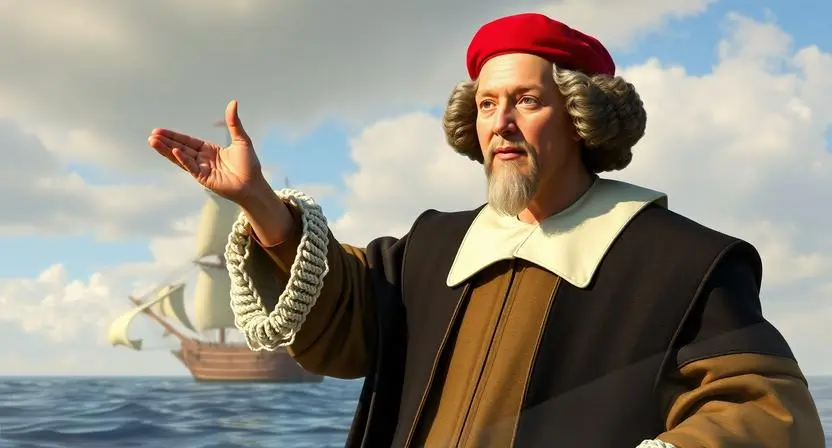
Today we are talking about generates a hyperrealistic image of christopher columbus, The advancement of artificial intelligence has transformed how we visualize historical figures. Modern technology generates a hyperrealistic image of Christopher Columbus with unprecedented accuracy and detail. These AI-powered tools can recreate the famous explorer’s likeness based on historical descriptions, portraits, and documented accounts from the 15th century. Digital artists and historians now collaborate to produce images that bring Columbus to life in ways never before possible. The fusion of historical research with cutting-edge image generation technology creates stunning visual representations that help us connect with history. These hyperrealistic depictions serve educational purposes while showcasing the remarkable capabilities of contemporary digital art tools and artificial intelligence systems.
How AI Technology Generates a Hyperrealistic Image of Christopher Columbus
Artificial intelligence utilizes sophisticated algorithms and neural networks to create detailed historical portraits. When the system generates a hyperrealistic image of Christopher Columbus, it analyzes countless data points including facial structure descriptions, period-accurate clothing, and environmental context. Machine learning models train on thousands of Renaissance-era portraits to understand artistic styles and anatomical proportions characteristic of that time period. The AI considers factors like lighting, skin texture, hair detail, and fabric rendering to achieve photorealistic results. Advanced rendering engines process these elements simultaneously, producing images with remarkable depth and authenticity. The technology continues evolving, offering increasingly accurate representations that blur the line between historical art and modern digital creation.
Historical Accuracy When You Generates a Hyperrealistic Image of Christopher Columbus
Creating authentic representations requires extensive historical research and careful attention to documented details. To generate a hyperrealistic image of Christopher Columbus accurately, creators must reference contemporary accounts, portraits painted during or shortly after his lifetime, and written descriptions from those who met him. Historical records suggest Columbus had auburn hair that whitened prematurely, a ruddy complexion from years at sea, and penetrating eyes. His clothing would reflect late 15th-century Genoese and Spanish fashion, featuring doublets, hose, and capes typical of navigators and nobility. Researchers consult museum collections, maritime historians, and Renaissance art experts to ensure every detail—from fabric textures to period-appropriate accessories—maintains historical integrity while leveraging modern rendering capabilities.
The Creative Process to Generates a Hyperrealistic Image of Christopher Columbus
The creation process involves multiple stages combining artistic vision with technological precision. Artists begin by gathering reference materials before using specialized software that generates a hyperrealistic image of Christopher Columbus through iterative refinement. Initial prompts describe physical characteristics, clothing, pose, and environmental setting in detailed text formats. The AI produces preliminary versions which artists then evaluate for historical accuracy and visual quality. Subsequent iterations refine facial features, adjust lighting conditions, enhance texture details, and perfect color palettes. Many creators use multiple AI platforms in combination with traditional digital painting techniques. This hybrid approach allows human creativity to guide artificial intelligence, resulting in images that balance historical authenticity with artistic interpretation and technical excellence.
Applications When Artists Generates a Hyperrealistic Image of Christopher Columbus
These hyperrealistic images serve numerous educational, commercial, and artistic purposes across various industries. Museums generate a hyperrealistic image of Christopher Columbus for interactive exhibits that engage visitors with immersive historical experiences. Educational institutions use these images in textbooks, presentations, and digital learning platforms to help students visualize historical figures more vividly. Documentary filmmakers incorporate such imagery for historical reenactments when period footage doesn’t exist. Publishers commission these images for book covers, magazine articles, and historical publications requiring compelling visual content. Gaming companies utilize hyperrealistic historical character designs for educational games and simulations. Virtual reality experiences transport users to the Age of Exploration with authentic-looking historical figures, creating memorable learning experiences that traditional photographs or paintings cannot achieve.
Future Developments That Generates a Hyperrealistic Image of Christopher Columbus
Emerging technologies promise even more sophisticated capabilities for historical visualization and digital art creation. Future systems that generate a hyperrealistic image of Christopher Columbus will incorporate three-dimensional modeling, allowing viewers to examine subjects from multiple angles. Integration with augmented reality will enable people to see life-sized historical figures in their actual environments through smartphone screens. Advanced AI will better understand nuanced historical contexts, automatically adjusting details based on specific time periods, locations, and circumstances. Voice synthesis and animation capabilities will create fully interactive historical figures capable of movement and speech. Quantum computing may eventually process such complex data instantaneously, producing perfect historical reconstructions. These innovations will revolutionize education, entertainment, and historical preservation, making the past more accessible and engaging for future generations.
Conclusion
The ability to generate a hyperrealistic image of Christopher Columbus represents a remarkable convergence of historical scholarship, artistic creativity, and technological innovation. These digital creations bridge centuries, allowing contemporary audiences to visualize historical figures with unprecedented clarity and detail. As artificial intelligence continues advancing, the accuracy and realism of such images will only improve, offering increasingly authentic windows into the past. This technology democratizes access to high-quality historical visualization, benefiting educators, students, researchers, and history enthusiasts worldwide. While debates about historical interpretation continue, the capacity to create detailed, accurate visual representations enriches our understanding of significant historical figures. The digital renaissance in historical imaging transforms how we preserve, share, and experience our collective human heritage for generations to come.














Leave a comment